Opening a bottle of Taurasi DOCG often marks the beginning of a special occasion. But one question comes up regularly: should you uncork it well in advance, pour it into a decanter, or serve it directly into the glass?
The answer depends on more than the name on the label. The vintage, how the bottle has evolved, its temperature and, above all, what the wine reveals at the first taste all matter. Here is how to make an informed choice without relying on rigid rules.
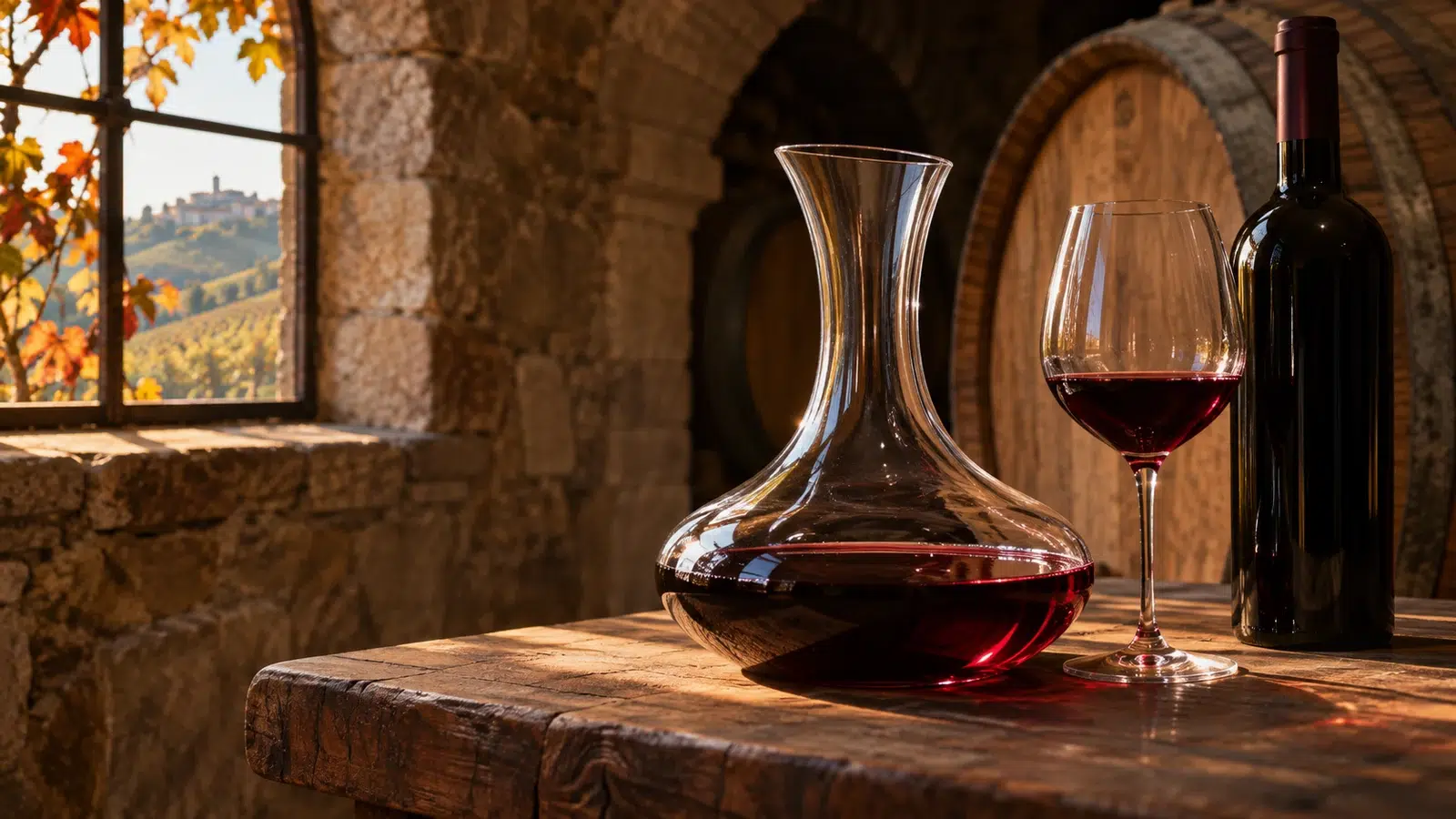
Why Taurasi can change in the glass
Taurasi DOCG is made from Aglianico grapes and is known for its structure, freshness and tannins. In younger wines, some characteristics may seem tightly knit at first: controlled exposure to air can make the aromatic profile easier to appreciate. In an already mature bottle, however, vigorous aeration may cause delicate aromas to fade.
The first piece of advice is therefore simple: taste before deciding. A wine does not automatically need decanting just because it is prestigious or aged.
Decanting and aeration are not the same thing
Decanting, in its strict sense, means carefully transferring wine to another vessel to separate it from any sediment in the bottle, particularly when the wine is mature. Aeration means increasing contact with air, which can help some initially closed wines express themselves.
A wide decanter and an energetic pour increase contact with air. A narrow carafe and a slow transfer are better when the main aim is to separate sediment while limiting aeration. These are different techniques, selected according to the wine.
When to use a decanter for Taurasi DOCG
For a young, structured Taurasi: pour a small amount into a glass. If the aromas seem restrained or the palate unusually tight, try transferring the wine to a carafe and check how it develops after about 15–20 minutes. In many cases, approximately 20–40 minutes can be a useful starting point, not a universal rule.
For a mature Taurasi: stand the bottle upright in advance if sediment is likely. Open it gently, taste it and, only if necessary, transfer it slowly to separate any deposits. Avoid leaving the wine in a wide decanter for extended periods when its bouquet is already open and delicate.
For a bottle that is ready to drink: there is no need for a decanter. A suitable glass and the natural pace of tasting may be enough.
Serving temperature matters as much as air
A complex red served too warm may emphasise the sensation of alcohol; served too cold, it may seem harder and more astringent while revealing fewer aromas. For Taurasi, around 16–18°C is a practical reference point to adapt to the individual wine and its surroundings.
Room temperature is not necessarily wine temperature. In a home heated to 22–24°C, it may help to bring the bottle to a slightly lower temperature before serving, without overchilling it.
How to serve Taurasi in five steps
1. Prepare the bottle. Keep it away from heat and, if sediment is present, let it rest upright.
2. Choose the glass. A sufficiently spacious glass helps you follow the aromas as they open without dispersing them too quickly.
3. Taste immediately. Observe the aromas, balance and tannic sensation: this is your starting point.
4. Decide whether air is needed. If the wine seems closed, try gradual aeration; if it is already expressive, avoid unnecessary intervention.
5. Taste again. Notice how it changes after a few minutes. The tasting, not the clock, indicates the best moment.
Taurasi, Campi Taurasini and Irpinia Aglianico: three styles, different choices
Even within the Aglianico family, different bottles may call for different serving approaches. Cantine Novera Taurasi DOCG expresses the grape’s more structured and complex side. Irpinia Campi Taurasini DOC offers a rounded, spicy interpretation, while Irpinia Aglianico DOC highlights a more direct, fruit-forward character.
None of these denominations inherently requires lengthy decanting. The best way to serve each wine depends on the individual bottle and respects its identity.
For a detailed comparison of Aglianico, Irpinia Campi Taurasini and Taurasi, read our guide: Aglianico vs Taurasi DOCG: What’s the Difference?
Three mistakes to avoid
Decanting every wine for two hours. There is no single duration for every bottle: excessive aeration can diminish some wines.
Serving red wine at the temperature of an overly warm room. A suitable serving temperature helps preserve balance and clarity.
Confusing sediment with a fault. Sediment in a mature red does not necessarily indicate a problem; it may simply require careful transfer.
Frequently asked questions
Is removing the cork an hour ahead enough? Not always. Contact between the wine and air through the narrow bottle neck is relatively limited. Pouring into a glass or transferring it carefully changes the exposed surface more directly.
Does a decanter always improve wine? No. It can benefit some bottles, but it does not replace the quality of the wine or correct faults.
What is the ideal way to serve an important Taurasi? Pay attention to temperature, taste first, aerate gradually if needed and choose a suitable glass. The aim is to respect the wine, not impose a ritual on it.
Conclusion: listen to the wine before intervening
With Taurasi, time works in the vineyard, in the cellar and in the glass. Opening a bottle well does not necessarily mean letting it breathe for a long time: it means creating the conditions in which it can express itself at its best.
To explore the character of Aglianico from Taurasi, discover Cantine Novera Taurasi DOCG. Wine importers and distributors can also contact our trade team for further information about the portfolio.
More from the Journal: Explore Wine Knowledge articles or browse the Cantine Novera Journal categories.